



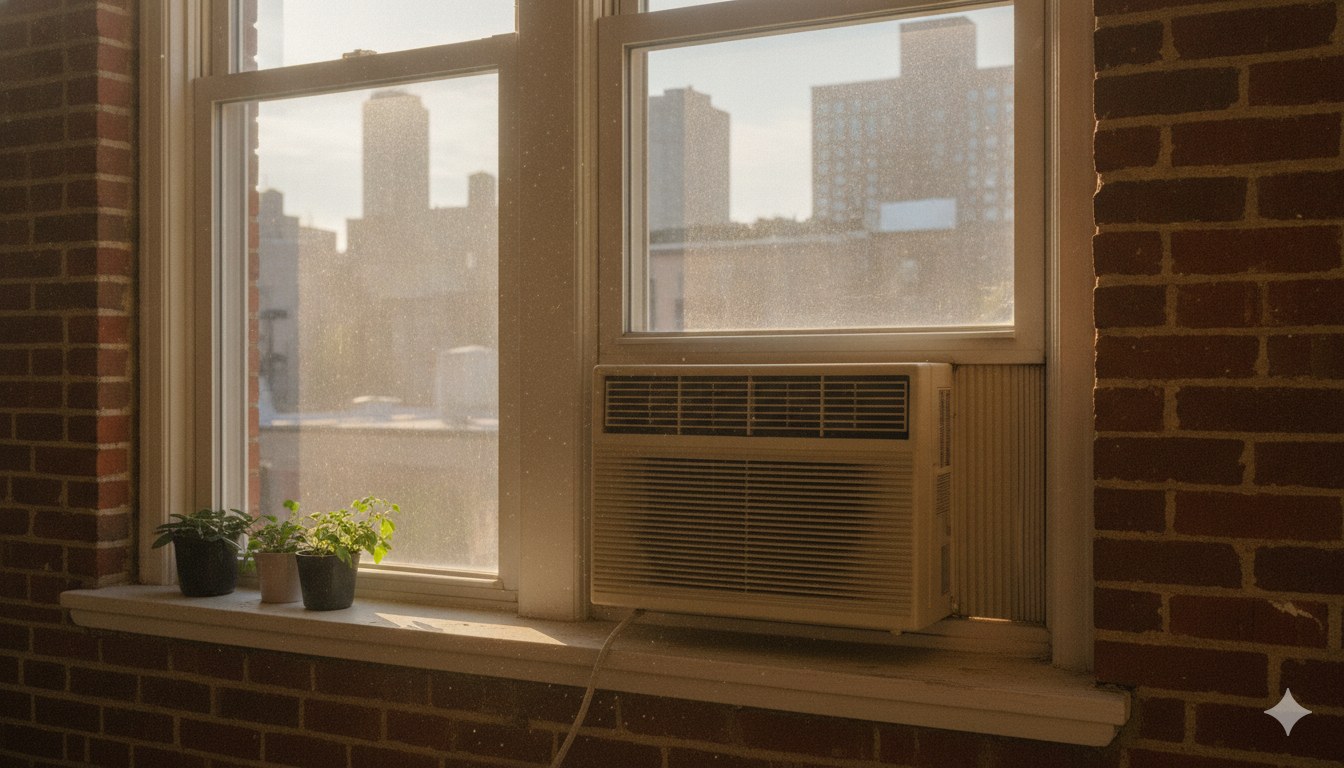
Every June, as temperatures creep into the 80s and New Yorkers start wrestling their window units back into service, our cleaning team sees the same thing: a lot of very surprised faces when they realize what's been sitting in their living room all winter.
We clean apartments across Brooklyn, Queens, and Manhattan year-round, and the window AC unit is one of the most reliably neglected objects in any NYC home. That's not a judgment — it's a reality of life in a city where space is tight, winters are long, and nobody wants to think about the appliance they won't need for another seven months. But what accumulates inside a window unit over a New York winter is genuinely worth knowing about before you flip that switch.
Here's what we actually find, why it matters for your health and your utility bill, and how we clean them using non-toxic products that won't leave your apartment smelling like a hospital.
Last spring, we were doing a pre-summer deep clean in a pre-war one-bedroom in Astoria. The tenant — a nurse, meticulous about her own space — asked us to tackle the AC unit while we were there. When we pulled the front panel, the filter was coated in a grey-black mat of combined debris: shed pet hair, cooking particulate from nine months of city air, and a faint but unmistakable bloom of mold along the lower drip tray. She hadn't run the unit since September. The mold wasn't visible from outside. There was no smell. She had no idea.
This is typical. Window AC units in NYC apartments face a perfect storm of conditions: the units sit dormant through the winter collecting indoor dust and humidity; the drip tray rarely fully dries; and the foam filters used in most residential units are porous enough to trap particles but not always easy to clean thoroughly. By the time June arrives, you may be breathing through a filter that's been slowly composting since autumn.
When we open up a neglected window unit, we typically find four categories of buildup:
This is the visible layer — grey, matted, and measurably reducing airflow. A clogged filter makes the motor work harder, which raises your electricity bill and shortens the unit's lifespan. In NYC's older rental stock, where landlords don't replace units until they die, that matters.
The drip tray collects condensate while the unit runs, and if the unit wasn't run long enough to fully dry out before the end of last season, standing water creates a warm, dark, humid environment. Mold thrives here. When you start the unit in June, the fan blows air directly over these surfaces. If you're concerned about broader mold issues in your apartment, our NYC apartment mold prevention guide covers the full picture.
We don't love saying it, but in New York City, a dark, undisturbed machine cavity is attractive to cockroaches and mice. We regularly find evidence — droppings, shed exoskeletons — especially in ground-floor and basement units. This is worth checking before you run the unit for the first time.
NYC's tap water isn't harsh by national standards, but window units that operate in areas with hard water (or that have had direct water exposure from storms or improper covers) can develop mineral scale on the coils that reduces cooling efficiency.
One of the things our clients ask us most often is: what products do you actually use? The short answer is that we lean heavily on non-toxic formulations for AC cleaning because the alternative — commercial coil cleaners — can off-gas aggressively in a small apartment. Here's our standard approach:
Step 1: Power off and unplug completely. This isn't optional. We wait at least 10 minutes before touching the interior.
Step 2: Remove and soak the filter. Most window AC filters slide out from the front panel. We soak them in warm water with a small amount of unscented dish soap (or a plant-based all-purpose cleaner), let them sit for 10–15 minutes, then rinse and air dry fully before reinstalling. Never run the unit with a wet filter.
Step 3: Vacuum the coils gently. Using a soft brush attachment, we vacuum both the evaporator coils (the front-facing fins) and the condenser coils at the back. Bent fins can be gently straightened with a coil fin comb — a cheap tool that makes a real difference in efficiency.
Step 4: Clean the drip tray. This is where most DIY cleaning falls short. The tray often requires removal to clean properly. We use diluted white vinegar on mold spots — it's effective against most household mold species and doesn't leave a chemical residue. For stubborn growth, we use a hydrogen peroxide solution (3%, standard drugstore strength) applied with a cloth rather than a spray, which avoids soaking the motor housing.
Step 5: Wipe down the cabinet and vents. A damp cloth with a small amount of all-purpose cleaner handles the exterior. Pay attention to the adjustable louvers — they trap dust in the gaps and are often forgotten.
Step 6: Dry everything fully before running. After reassembly, we leave the unit unplugged for at least two hours if any interior moisture was present. Running a fan to accelerate drying is worth the extra time.
DIY cleaning handles surface maintenance. But there are situations where it makes sense to bring in help:
Our home cleaning service includes AC unit cleaning as part of our summer pre-clean package. We have the tools to handle full coil decontamination and can spot issues that might warrant a service call to an HVAC tech.
If you're cleaning your own unit, a few product principles we stand behind:
For a non-toxic option that pairs well with home cleaning, our carries plant-based formulations designed for exactly this kind of application.
While you have the unit partially pulled out, check the foam seal around the edges where the unit meets the window frame. In NYC's older double-hung windows, this foam degrades and compresses over time, leaving gaps that let in hot outdoor air (and noise, and occasionally rain). A hardware store foam weatherstrip kit costs a few dollars and makes a meaningful difference in cooling efficiency.
The requires that AC installations don't create openings larger than a half-inch — worth checking if you're in a rental. And the identifies mold as a significant indoor allergen trigger, particularly relevant for NYC's dense apartment living.



-01.png)